Artists working abstractly often emphasize the “character” of a line (looseness, thickness, lightness) over its descriptive properties (outlining form, defining value).
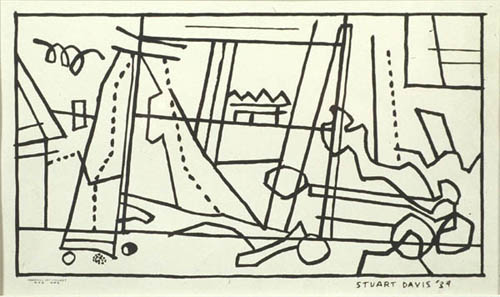
Stuart Davis [b. 1892: Philadelphia, Pennsylvania – d. 1964: New York, New York]
lithograph on paper
20 by 24 inches
Property Transfer from the Illinois State Library
Collection of the Illinois State Museum
After training in a loosely academic style under the direction of Robert Henri at the Art Students League, in New York City, Davis was “converted” to the Modernist movement upon viewing the Armory Show when it was mounted in New York in 1913. Reflecting his early experience with the Ashcan School and its strong emphasis on gritty realism, Davis began to create paintings that used popular culture — store signs, product labels, jazz music — as inspiration, but depicted them in flat, abstract patterns of color and form.
This lithograph dates from his work with the Works Progress Administration project of the Great Depression (project documentation can be seen in the lower left hand corner) and is a lively dance of line that is descriptive without being definitive. Davis did not work in Illinois but this important work came to the Illinois State Museum when the Works Progress Administration offices were closed down in Chicago in 1943.